
Second Wind Karate
The secret to karate mastery is embedded in old age.
Karate for adults over fifty — taught at home, at your own pace. No belts, no sparring, only one person to keep up with — and it’s you.
Karate for adults over fifty — taught at home, at your own pace. No belts, no sparring, only one person to keep up with — and it’s you.
The Benefits
Our karate is centred on the principle of movements which can fit anyone’s body — improving you in many aspects.
Physical ability
Strengthen your lower body muscles
Variety of stances and positions increasing muscle power in the entire leg - contributing directly to posture change and your ability to sit and stand.
Improve the coordination between your feet and your center of mass
Second Wind Karate teaches you to gain balance from your foundation by creating the right coordination between your feet and your center of mass to give a firm sense of confidence in your stability.
Studies of comparable movement practices in older adults. None was conducted on this course. Read them in full →
Optimal movement mechanics including walking and common functional movements are embedded in our karate
Practice form (kata) teaches weight transfer - pushing off the back heel, driving movement through the hip, and gliding the feet lightly rather than dragging them. This trains the body to move with maximum mechanical efficiency and minimal wasted energy.
Mental ability
Martial arts increase neural connectivity and growth through increased BDNF proteins.
Through Learning and executing multi-step movement patterns (kata) requires translating mental visual representations into precise physical actions. Memorizing these sequences and continuously adjusting body orientation in space stimulates brain pathways associated with spatial memory and cognitive flexibility, helping keep the mind sharp and adaptable.
One is on martial arts; the others are comparable movement practices. None was conducted on this course. Read them in full →
Focus on multiple details improves the coordination and decreases falls
Second Wind Karate demands simultaneous focus on physical balance, intentional breath control, and posture alignment while remembering the next movement in a sequence. Operating under this continuous dynamic attention trains executive function and working memory far more actively than repetitive, single-motion exercises like walking or stationary biking.
Studies of comparable movement practices in older adults. None was conducted on this course. Read them in full →
The focus required in karate creates a state of mindfulness
The deliberate focus required to execute strikes, blocks, and stances creates a state of active mindfulness. By grounding attention entirely in immediate physical control and rhythmic breathing, it lowers cortisol levels, reduces anxiety, and fosters a calm, centered mental state.
Studies of mind–body and mindfulness programmes in older adults. None was conducted on this course. Read them in full →
Social
Spiritual
The two teachers
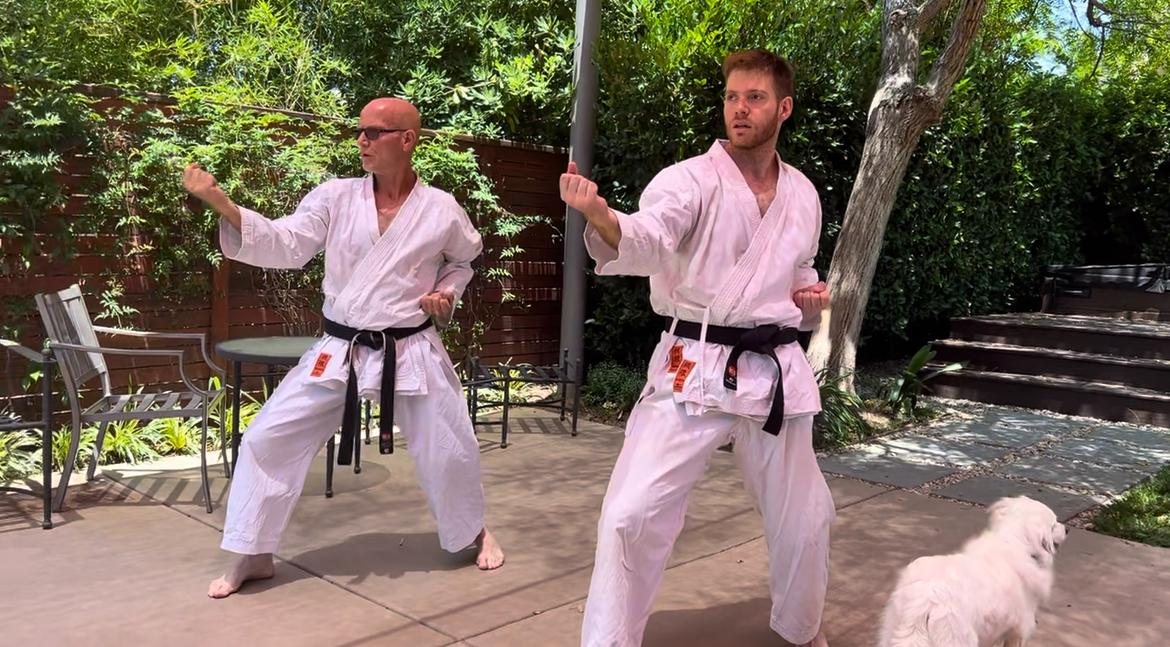
Eran Shine · Karate · founder of Second Wind Karate
Hi, my name is Eran Shine. I have been studying traditional Japanese karate for over 40 years.
After a series of injuries following 2010 I came to the understanding that old age and health problems aren’t hurdles in mastering movement efficiency, they are actually the pathways to reach efficiency and mastery.
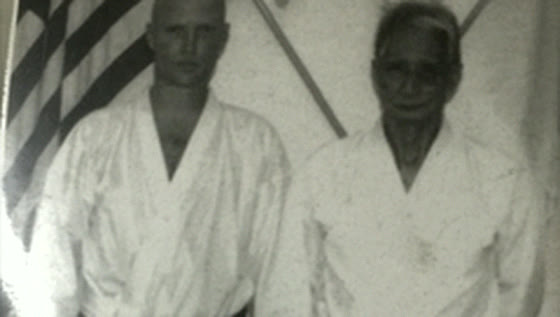
I recall my former Sensei, Nishiyama, who in his old age could barely walk and moved in slow motion yet he was untouchable, even by his elite students.
My life mission has become to share this path with you toward better physical and mental condition especially when weaknesses are threatening to take over.
Turning our setbacks into a comeback
Ori Shine, MD · Medicine & karate
I’m Ori Shine, I am Eran’s son, a doctor, and have been studying karate since my childhood.
As a doctor, my life goal has always been to help people improve their quality of life.
As I have gotten deeper into both medicine and karate, the connection between the two has become clear. Our Karate based principles have the potential for physical and mental benefits if practiced in the right way.
Within the principles of karate, there is evidence backed by the research, that physical stability, cognitive health, and even chronic pain can improve, and I am honored to impart this lifelong practice with you.
Where this comes from
Our method is rooted in traditional karate and the teachings of Sensei Hidetaka Nishiyama. Eran moved to Los Angeles in 1986 to train under him directly, witnessing firsthand how an aging master—barely able to walk—remained completely untouchable to his elite students. Experiencing this mastery personally in later years became the ultimate foundation and inspiration for our program.
Start here — free
A short preview of the lessons. Nothing to fill in to watch it.
The preview goes here. Roy is finding the clip.
The first three lessons are free.
Already started? Open your lessons.
“My knee is bad. My back is bad. I can’t kneel.”
Then you are in the right room. Eran has an artificial heart rhythm, one working eye and a nerve disease, and he trains every day. Nothing in the lessons requires you to kneel or to get down onto the floor. Tell us what your body does and does not do, and the work is set from there.
“I have never done a martial art in my life.”
Most people who start with Eran begin after fifty, and many begin from nothing. There is no grading, no sparring and nobody to keep up with.
If you have never trained. Then you have no bad habits to unlearn. Nothing has been engrained wrong, so what you study, you study once and correctly. That is the shorter road, not the longer one.
If you have trained before. Much of it will be familiar — the stances, the count, the shape of an hour in a dojo. What is new is what the movement is for, and where the power comes from once speed is gone.
Either way, the first thing you learn is how to make a fist — and people who have trained for thirty years are still working on it.
“I am too old for this.”
That sentence is the reason the course exists. The argument here is not that you can still manage karate at your age. It is that the things age takes away are the things that were hiding the karate.
“I will sign up and stop after three weeks.”
Possibly. The first three lessons are free, so finding out costs you nothing but an email address. What we can do is make the next lesson obvious: the library is ordered from the beginning rather than piled up, so you are never standing in front of a menu deciding. What we cannot do is promise you will keep going.
“Is this safe for me?”
We are not able to answer that, and anyone who answers it without knowing you is not worth listening to. Ask your own doctor, and tell us what they say.